Click here to download a Printable version (English only)
What is HighScope?
Families hear the teachers and other ACHR program staff talk about using the HighScope Curriculum in the classroom. But, what is HighScope? This is the first in a series of handouts that you will receive describing the HighScope Curriculum — what it is, and how you can support it.
HighScope’s goals for young children are pretty much the same as the goals most of us have for our children. To:
- Learn through active involvement with people, material, events and ideas.
- Become independent, responsible, and confident–ready for school and life.
- Develop critical thinking and problem-solving skills.
- Learn to plan, carry out, and talk about activities and then discuss what they learned while doing them.
- Gain knowledge and skills in areas including language, literacy, social-emotional skills, movement, logical thinking, math, science. . .
An important part of the HighScope approach is active, participatory learning — involving children in experiences with a variety of people, materials, events and ideas. In other words, HighScope encourages learning by doing and by talking about it. While your child is in Head Start, he will be learning how to plan activities, carry them out, and talk about what he has done. To the child, this is enjoyable.
Other Key Parts of HighScope Include:
Adult/Child Interaction
Adults talk with the children at their level to understand what each child is learning and expand on that learning. Through conversation and questions teachers help children build vocabulary and thinking skills. They also encourage the children to talk and work together and to learn to solve problems and disagreements.
A Place to Learn that is Inviting and Organized
Your child will be active in the Head Start classroom visiting the different interest areas that are in each room. During part of the day, your child may choose which area/s he wants to visit. There are both pictures and labels in each area showing children where materials are and what choices are available. For example, in the art area there may be a sign saying Art Area and pictures of crayons, markers, paint and paper. Children are soon able to recognize what these symbols stand for. This combination helps your child find the area and the materials he wants in the area and to be able to put things back in the right places. At the same time, children are practicing important beginning reading, writing and sorting/matching skills. Your child is also learning to be independent.
Daily Routines. Using consistent daily classroom routines helps your child know what to expect. When he feels comfortable and safe at school, he is able to focus on learning. During the day, Head Start teachers are listening and watching to see what interests your child has at that time and where they are in their learning and then the teacher plans activities around the children’s interests and needs. Your child will spend time both inside and outside each day. A variety of experiences using their minds and bodies strengthens children in all areas of their development. Outside times give children opportunities for heart-healthy exercise and develop their large muscles and coordination. Fresh air and time to explore nature help children stay healthy and learn more about the world around them.
Observation-Assessment: In the HighScope Curriculum teachers write down notes about what children are doing and saying and use these to plan for new activities that will encourage additional learning. You and your child’s teachers are able to discuss your child’s progress and set goals together.
What can you do at home?
You are an active part of your child’s learning at home. For example, when your child asks you about what you are cooking, you can tell your child what you are doing/why. “I am putting the cake mix, eggs, oil, and water into this bowl. Now I will use a big spoon to stir it. I am pouring it in the pan and putting it in the oven to bake. What do you think it will look like when it gets done?” By talking to your child about what you are doing, you help build his communication and language skills.
At home, talk to your child about his plans. Then talk to him while he carries out his plans. Afterwards talk to him about what he learned from the experience.
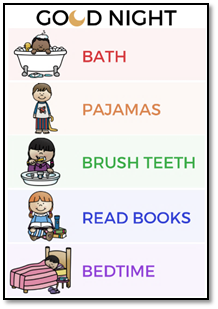
Have daily routines in your home such as scheduled times for supper, bath time, story time, and bedtime. A schedule helps your child know what to expect. It also helps him feel safe and independent.
SAMPLE AM/PM HOME ROUTINES

The ACHR Child Development program staff wants you to know that you are very welcome to visit your child’s classroom. Parents and ACHR staff are partners in your child’s growth and development. We can always use volunteers to help us with our very busy and active young learners. If after you have read the handout and you have questions, please ask your child’s teacher.